
What a vacant month really costs
I have the same conversation with owners every month. They want a certain number for the unit. I tell them I can get it. Then I tell them the part they don’t want to hear.
I can get you your price. You won’t like how long it takes. Or I can get you rented by Friday. You won’t like the price. Every pricing conversation lives between those two sentences.
The rental market is every other market
Put a product on a shelf and overprice it, and it sits. Put it on sale, and it’s gone by the weekend. We all know this. We shop this way at the grocery store every week. When we’re the ones selling, we know overpriced means slow.
Then we get to rentals and forget all of it.
I think it’s because we got spoiled. There was a stretch where you could list a house at almost any number and it would rent in a couple of days, because there was nothing else on the market. That stretch is over. It’s a renter’s market now. You can still list at whatever price you want. It just isn’t going to rent the way you remember.
Two months is four grand
Here’s the math owners aren’t doing, because they’re still thinking in terms of a week or two on market. At $2,000 a month, if the unit takes two months to rent, you just lost four thousand dollars. That’s not complicated. It’s just not the arithmetic anyone runs when they’re deciding whether to list at $2,100 instead of $2,000.
So let’s run it. Say the house would rent at $2,000 and you hold out for $2,100. That extra hundred is worth $1,200 over a twelve-month lease. Every day the unit sits empty costs about $67.
| Extra weeks of vacancy | Rent lost | Premium gained over 12 months | Net |
|---|---|---|---|
| 2 weeks | $933 | $1,200 | +$267 |
| 3 weeks | $1,400 | $1,200 | −$200 |
| 4 weeks | $1,867 | $1,200 | −$667 |
| 8 weeks | $3,733 | $1,200 | −$2,533 |
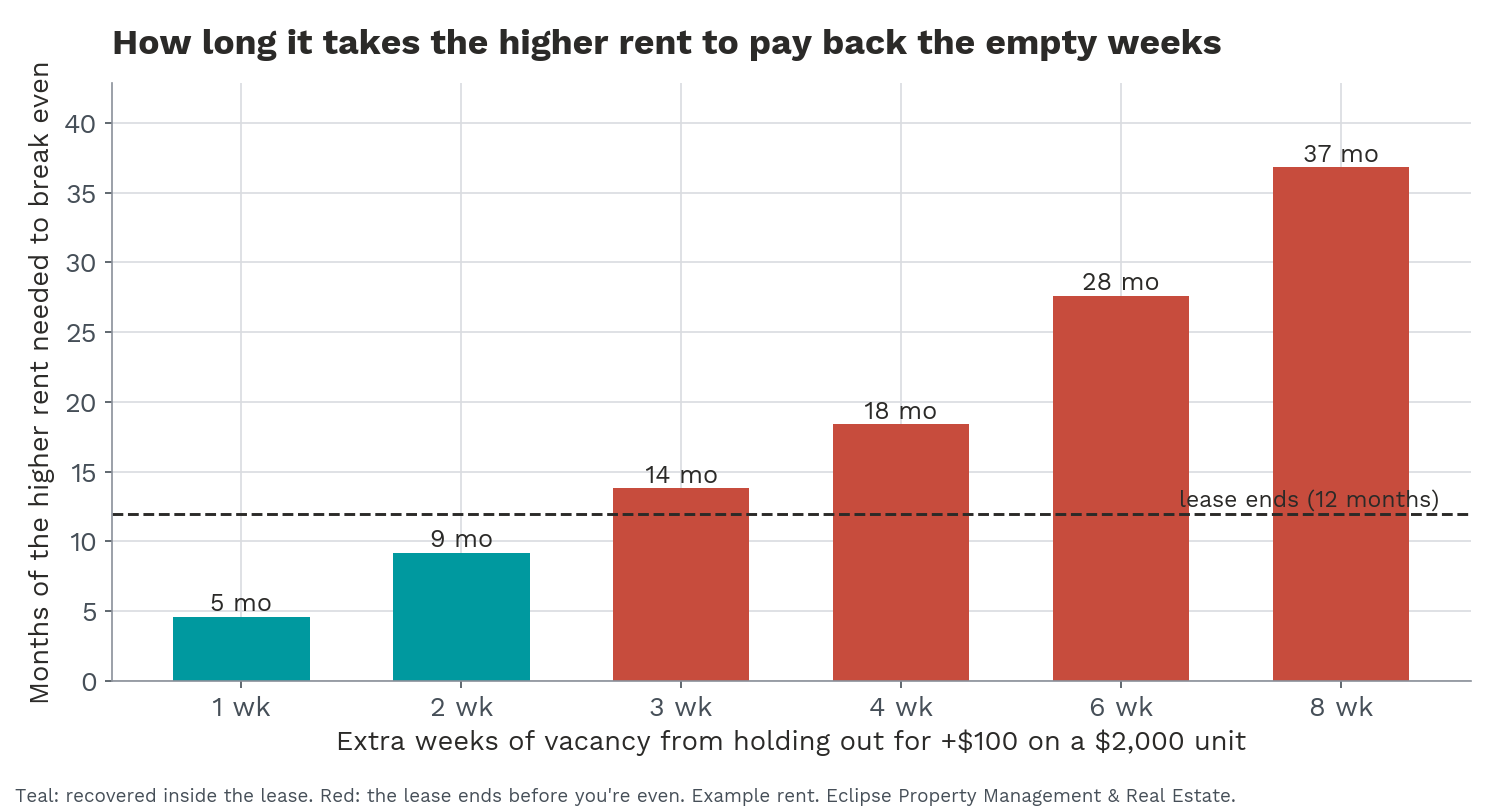
Break-even is about three weeks. Past that, you are paying for the privilege of a bigger number on the lease. And at four extra weeks of vacancy, it takes about nineteen months of the higher rent to get back to even. The lease is twelve.
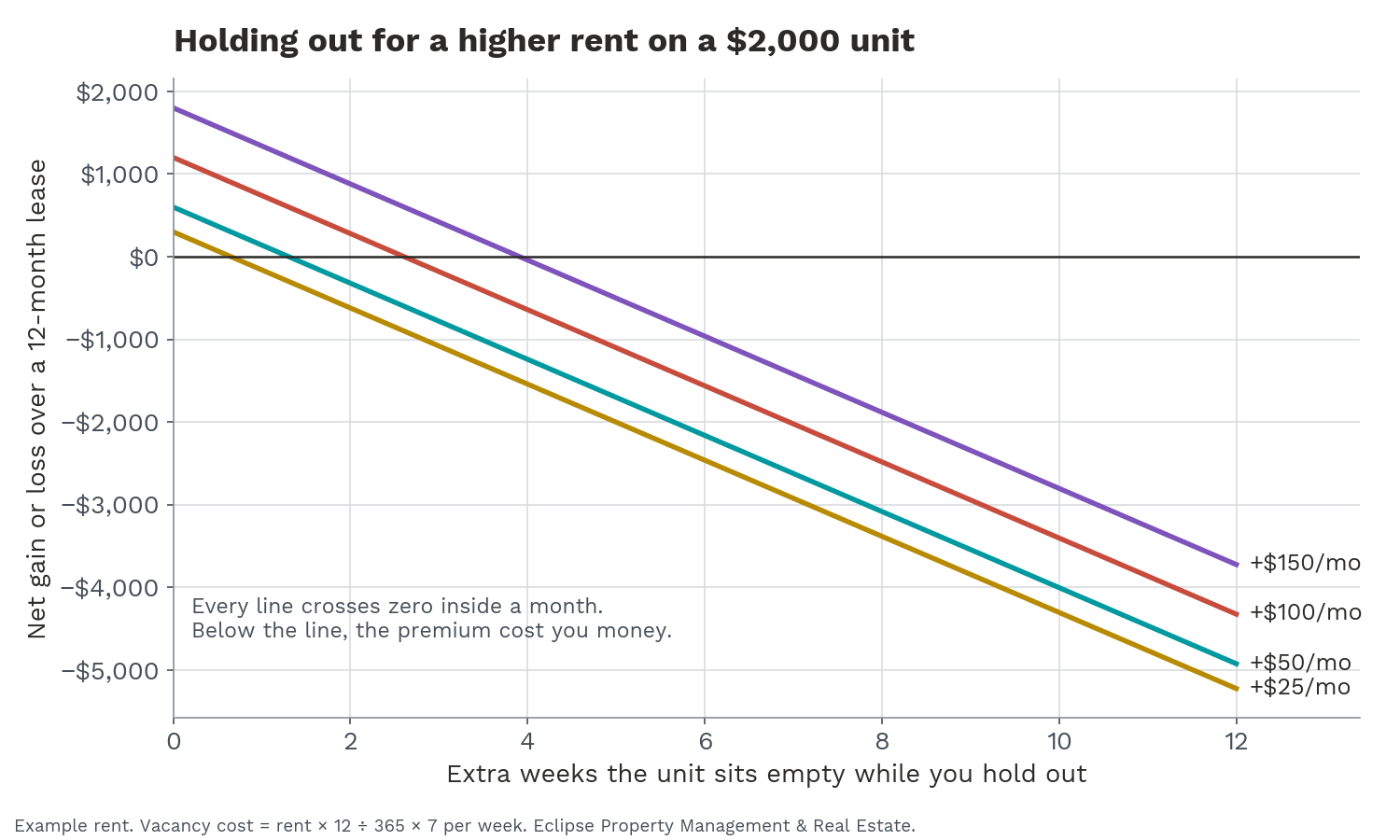
That’s one example rent. Here’s the same math across four rents and four premiums. Read it as “how many empty weeks before the higher rent is a loss.”
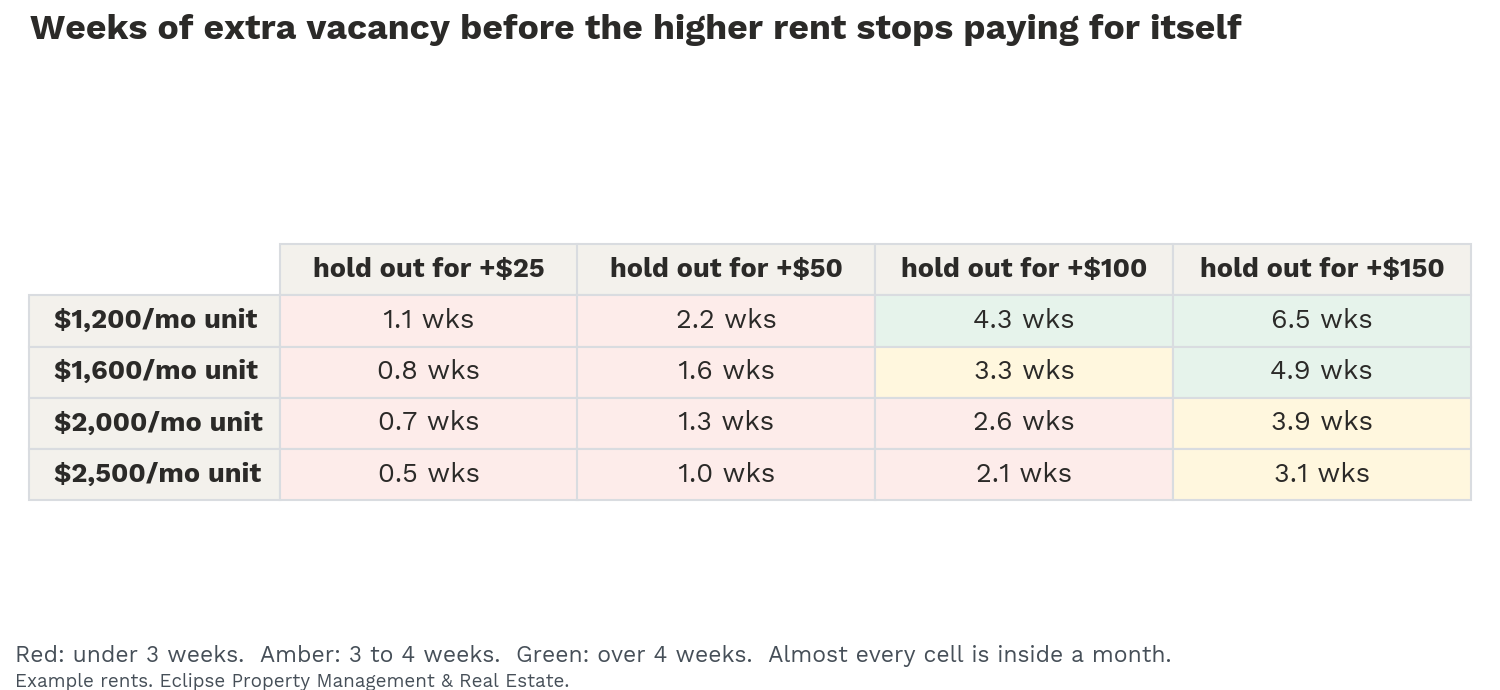
Almost every cell is inside a month, and three weeks is not a long time for a unit to sit in this market.
And here’s what it looks like on one house over one year. Same house, same tenant. One listed at $2,000 and rented in two weeks. One listed at $2,100 and rented in seven.
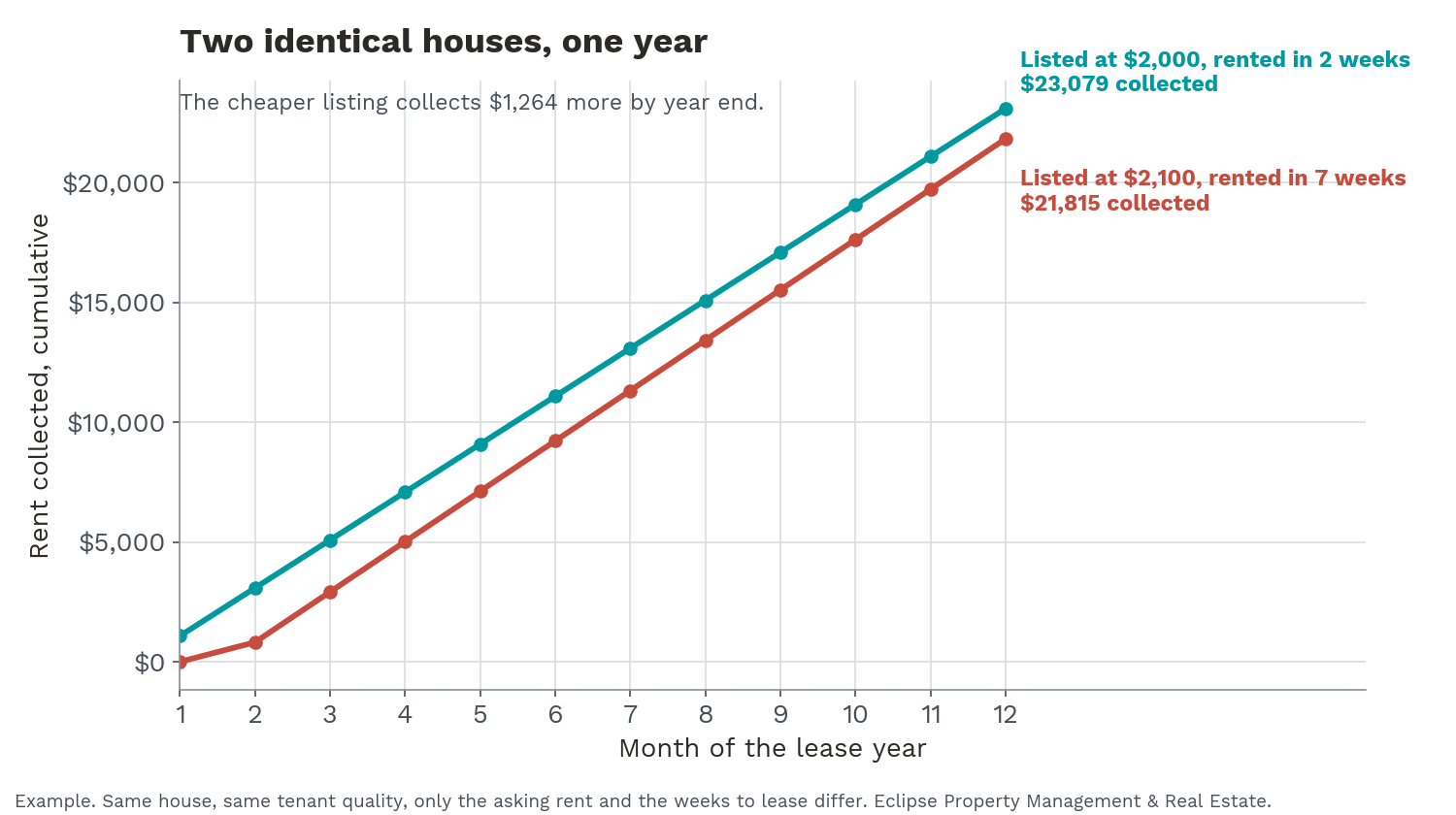
The cheaper listing collected about $1,260 more by year end. The higher number on the lease lost.
It’s a mindset problem, not a pricing problem
The mindset is “I want the most I can get for this unit.” That’s a fine thing to want. It’s just not how you make the most money, because every day of vacancy is coming out of the same pocket.
If a slightly lower rent gets the place filled two weeks sooner, you made more. Not less. More.
This is especially true on a unit that’s new to you, where nobody actually knows what the market rent is yet. You’re guessing. The temptation is to guess high. Come in a little under, get it filled, and raise it in year two or three once you know where the market really is. A low first-year rent is recoverable. A long first-year vacancy isn’t.
Landlords and investors
A landlord thinks in months. An investor thinks in decades. Same property, same tenant, same vacancy, completely different decision. One or two years slightly under market doesn’t hurt a thirty-year investor at all. Six weeks of vacancy hurts everyone.
If you own a rental and you’re holding out for a number, ask yourself which one you are. Then do the math above with your own rent. I’ll do it with you if you want: 719.581.RENT or the owner form on RentEclipse.com.
The $2,000 example is illustrative, not a market figure. Eclipse Property Management & Real Estate.
A note on AI. The thoughts, experience, and opinions here are mine. This is not AI content. It’s not written by AI. I didn’t just give it a prompt and out popped this blogpost. This is real. However, I do use AI as a writing and editing tool to help shape and polish the final text, and to check facts and figures before publishing. If it feels too polished to be really written by Chuck, or a detector flags this post, that’s why. AI is a tool, and I used it to help with the words, spelling, and grammar, not the thinking.